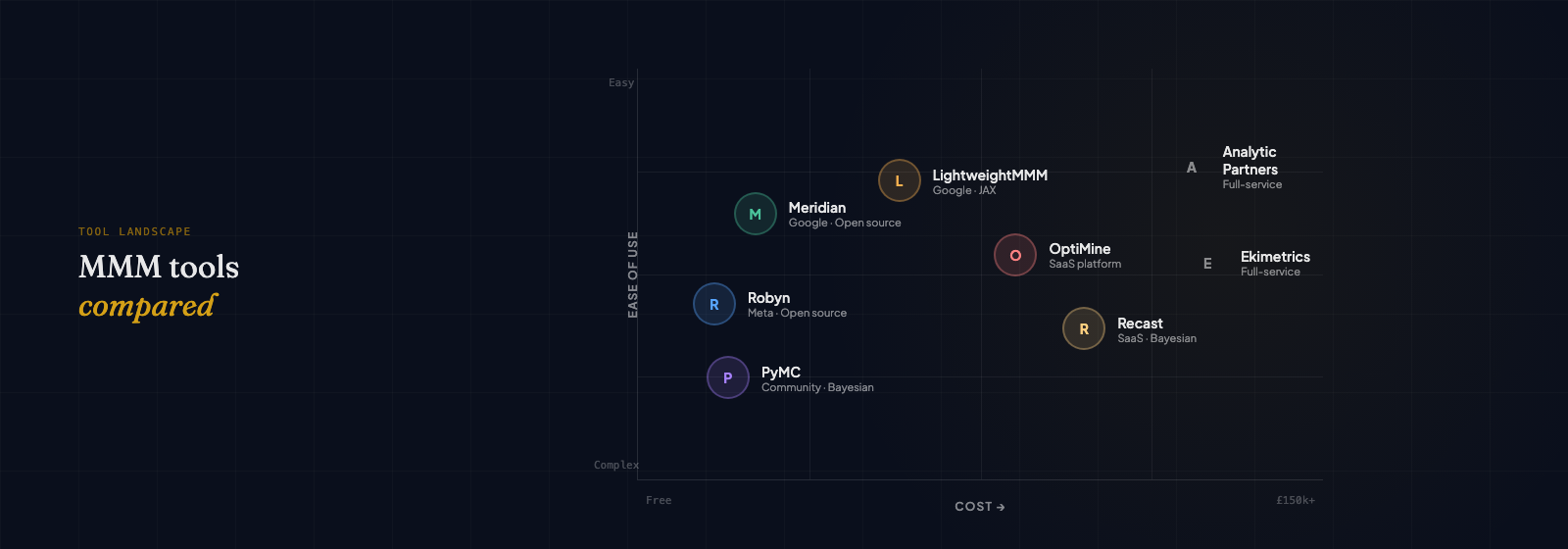
Two types of tools
This is where most MMM comparisons go wrong. They conflate two completely different things: modelling tools and service providers. Conflating them is like comparing a spreadsheet software package to a management consulting firm.
Modelling tools are the statistical engine. You give them clean, model-ready data and they output estimates of how each marketing channel influences sales. Meta Robyn, Google Meridian, and PyMC are all modelling tools. They're mostly free or low-cost. The code is open-source and you run it yourself.
Service providers do the entire job for you: data collection, cleaning, validation, modelling, analysis, and recommendations. Analytic Partners, Nielsen, and Ekimetrics are service providers. They charge £80k-£150k because they're not selling you software. They're selling you the output of their data science teams.
The practical consequence: you can use a free modelling tool and still spend three months (and £30k) on data preparation. Conversely, you can pay an agency £120k and end up with a model you don't understand and can't update yourself. The tool itself is just one piece of the picture.
The real choice isn't about tool cost: it's about where you want the work and cost to happen. Do you have internal data science capability? Do you have months to spend on data prep? Do you need vendor lock-in or independence? Those questions matter more than the price of the software.
Open-source modelling tools
Meta Robyn
What it does: Robyn is Meta's open-source MMM package. It uses ridge regression combined with Nevergrad for hyperparameter optimisation. It's designed for teams with decent data science capability who have clean, channel-level spend and sales data.
Real strengths: Excellent documentation. Large community (over 1,200 GitHub stars, actively used by digital marketing teams globally). Works well with granular digital data. Good for companies with 12+ months of historical data across multiple channels.
The catch: Assumes your data is already clean and structured. If your data comes from fragmented sources (email platform, Google Ads, Facebook Ads, internal CRM, analytics platform), you'll spend 6-10 weeks just getting it model-ready. Robyn won't help with that.
Google Meridian
What it does: Meridian is Google's newer Bayesian take on MMM. It uses causal inference methods and integrates well with Google's own data ecosystem (Google Ads, GA4). Better uncertainty quantification than traditional regression approaches.
Real strengths: Newer thinking on Bayesian statistics applied to MMM. Geo-level modelling capability (useful for testing in specific markets). Integrates cleanly with Google Ads and search data. Actively developed and will likely see more features added.
The catch: Same data prep requirement as Robyn. Also, Bayesian models require more statistical fluency to set up and interpret correctly. The learning curve is steeper.
PyMC Marketing
What it does: PyMC is a Bayesian modelling library with a marketing-specific API layer on top. More flexible than Robyn or Meridian, but requires deeper Python and Bayesian statistics knowledge to use effectively.
Real strengths: Maximum flexibility. If you have unusual data structures, complex relationships you want to model, or specific business constraints, PyMC can handle them. Performance is strong (2-20x faster sampling than Meridian in some benchmarks).
The catch: You need skilled practitioners. This isn't a tool for marketing analysts without statistical training. Setup time is longer. Interpretation requires understanding Bayesian posteriors and credible intervals.
Full-service analytics firms
Analytic Partners
The industry standard. Used by most Fortune 500 brands. They collect your data, clean it, build the model, and present recommendations. Their methodology is proprietary. They're good at it: complex multi-market rollouts, deep category expertise, trusted stakeholder relationships.
Trade-offs: Expensive. Slow timeline (3-6 months typical). You depend on them for insights and updates. Some clients report that once the engagement ends, the model sits unused.
Nielsen MMM
Strong heritage in consumer goods. They have panel data and retail tracking that can be valuable for CPG brands. But the market is shifting toward faster, cheaper alternatives, and Nielsen's pricing model hasn't evolved accordingly.
Trade-offs: Slower than newer providers. Panel data is valuable for FMCG but less useful for direct-to-consumer or service brands. Expensive relative to alternatives.
Ekimetrics
Strong in continental Europe and specialized in luxury, beauty, and fashion brands. Work with major clients like Pernod Ricard and LVMH. Deep category expertise and sophisticated approach to seasonality and multi-market complexity.
Trade-offs: Pricey. Particularly strong for luxury but overkill for straightforward e-commerce brands. Long timelines.
Gain Theory
A different model from the big three. Gain Theory focuses on business driver modelling: not just media, but all factors affecting sales (competitor activity, distribution, macroeconomic shifts). More accessible pricing and faster timelines than enterprise consultancies.
Trade-offs: Smaller team than Analytic Partners. Less established brand in some markets. But genuinely good value for mid-market brands.
The missing middle
Here's the problem that most MMM providers don't acknowledge: there's a massive gap between free modelling tools and £100k agencies.
Scenario one: you use Robyn. Cost: £0. Timeline: 6-8 weeks of internal effort (if you have the capability). What you spend time on: chasing data from 8 different platforms, reformatting it, aligning taxonomies, checking for gaps, validating that the data is clean. By week 4, your team is tired and the finance team still hasn't sent the spend data. This is the job nobody wants to do, and it's why many teams try MMM once, struggle, and abandon it.
Scenario two: you hire Analytic Partners. Cost: £120k. Timeline: 5 months. What you get: beautiful PowerPoint, clear recommendations, stakeholder confidence. What you lose: understanding of the underlying data and model. The consultants leave. You have no way to update it. The model becomes a one-time exercise.
The missing middle is where the real opportunity is: automated data preparation that transforms raw data into model-ready datasets in days instead of weeks. That's where newer tools are starting to sit.
Tools that automate the data prep step let you use free modelling engines (Robyn, Meridian) without the 80% overhead. You avoid the 6-week slog and the £100k bill.
MMM tools vary by cost, complexity, and implementation approach
How to choose
If you have strong internal data science capability
Use an open-source model (Robyn for straightforward cases, Meridian for geo-level work, PyMC if you need flexibility). Budget for 6-10 weeks of internal data prep work. This costs you almost nothing in cash but quite a bit in time. Total cost: £5k-£15k (internal labour).
If you want hands-off results and can afford the premium
Hire Analytic Partners or Ekimetrics. You'll pay £100k+. You'll get a well-executed model and good stakeholder alignment. Accept that it's a one-off project unless you budget for annual refreshes.
If you want speed, control, and cost efficiency
The hybrid approach: use a tool that automates data preparation, then run an open-source model through it, then have experienced practitioners validate and interpret the results. Cost: £15k-£40k. Timeline: 3-4 weeks. You own the model and can update it yourself.
The hybrid approach is where the market is moving. It combines the independence of open-source tools with the practicality of avoiding the manual data work.