What is Marketing Mix Modelling?
Marketing Mix Modelling is a statistical technique that measures how different marketing activities drive sales. It answers a simple question: which of your marketing channels work, and how much should you spend on each one?
You have multiple channels. TV, digital display, search, paid social, out-of-home, email, promotions, pricing changes. They all affect sales, but you can't tell which one is doing what. Traditional digital tracking assigns credit to the last click. It's wrong. A customer might see your TV ad, think about it, search for you later, and digital gets all the credit.
MMM cuts through this by finding statistical patterns. It looks at historical data: what you spent on each channel, when you spent it, and what your sales were. Then it builds a model that estimates the contribution of each channel.
The core insight: MMM separates signal from noise. It finds the real effects buried in noisy, real-world data.
How does it work?
The process has three distinct stages: data assembly, modelling, and interpretation.
Step 1: Data collection
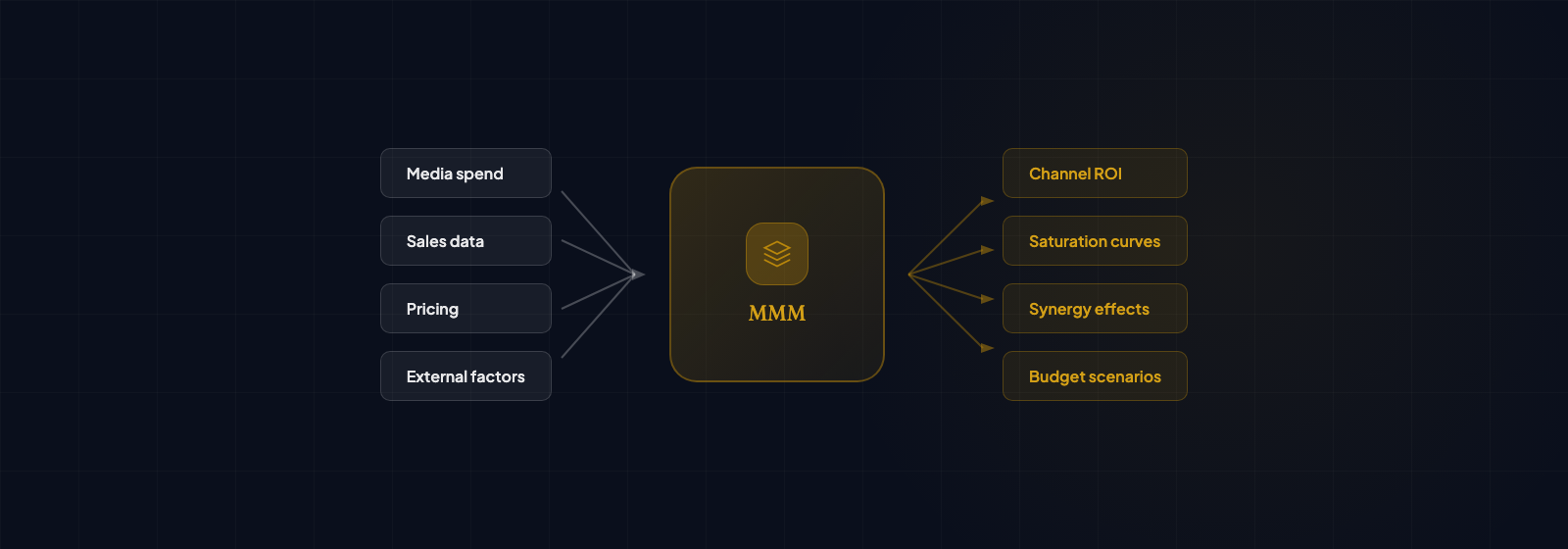
You gather historical data on three things. First, your marketing spend: how much went to TV, digital, outdoor, everything else. Second, your sales data: weekly or monthly revenue (or units sold). Third, any relevant external factors: promotional calendars, competitor activity, seasonality, weather, economic data.
This typically goes back 2-3 years minimum. More is better. The model needs enough variation in your spend across channels to detect their effects. If you spent the same amount every month, it's impossible to measure impact.
Step 2: Regression analysis (explained simply)
The modelling engine uses regression analysis. In non-technical terms: it finds the best-fit line through a cloud of scattered data points.
Imagine plotting spend vs. sales on a graph. You'd see correlation. More spend generally means more sales. But not perfectly. There's noise from seasonality, competitor activity, economy, other factors. Regression finds the underlying pattern despite the noise.
The clever part — MMM models use elasticity curves rather than straight lines. This captures diminishing returns. Your first £10,000 spent on TV might generate £50,000 in sales. Your second £10,000 might only generate £30,000. The more you spend, the less efficient each pound becomes. The model measures this curve for each channel.
Step 3: What comes out
The output is what makes MMM valuable:
- Channel ROI: How much revenue each channel generated per pound spent (after controlling for external factors)
- Diminishing returns curves: How ROI changes as you increase spend on a channel
- Halo effects: How channels influence each other (e.g., does paid search amplify TV effectiveness?)
- Scenario planning: If I cut TV spend by 20% and shift it to digital, what happens to revenue?
- Budget allocation recommendations: Where to reallocate budget for maximum impact
This is what agencies charge £100k+ for. Not because the math is complicated. Because the hard work is getting clean data ready for the model.
MMM transforms historical marketing spend and sales data into actionable channel ROI insights
Example channel ROI ranking: digital channels deliver higher returns than traditional media
Why does it matter right now?
Three forces are making MMM essential in 2026.
First: Cookie deprecation. Chrome is finally killing third-party cookies. Attribution models that relied on user-level tracking are breaking down. You can't track a customer across websites anymore. Digital attribution is becoming unreliable precisely when you need it most.
Second: Cross-channel complexity. Marketing isn't just digital anymore. You've got TV, OOH, retail partnerships, direct mail, in-store activations. Attribution tools can only track digital. MMM is the only method that measures everything together in one model.
Third: Privacy regulation. GDPR, CCPA, and similar laws are restricting data collection. First-party tracking works, but it's limited. MMM doesn't need user-level data. It works with aggregated historical spend and sales data. It's naturally privacy-compliant.
Traditional attribution is breaking. MMM works precisely when attribution fails: across channels, across time, without relying on individual user tracking.
Which industries use MMM?
Historically, FMCG (fast-moving consumer goods) dominated MMM adoption. Companies like Unilever, Nestlé, Procter & Gamble have been running MMM for 15+ years. The math worked: high-volume businesses where small percentage improvements in ROI translate to millions in profit.
But MMM is spreading:
- Retail: Understanding how offline and online channels interact. Store traffic vs. digital traffic.
- Automotive: Long consideration cycles. Need to measure how awareness-building (TV, OOH) influences purchase cycles.
- Financial services: Complex buying journeys. Banks and insurance companies use MMM to optimise across channels.
- Telecoms: Highly competitive markets with multiple campaigns running simultaneously. Need to isolate channel effects.
- Travel and hospitality: Measuring seasonal effects and how advertising drives bookings.
The common thread: significant marketing budgets spent across multiple channels, sales data that can be aggregated to weekly or monthly level, and enough spend variation to detect patterns.
What can MMM tell you?
Be clear on what MMM is good for and what it isn't.
MMM is excellent for:
- Understanding which channels drive sales
- Measuring halo effects between channels
- Identifying diminishing returns curves
- Optimising budget allocation across channels
- Measuring external factors (weather, competitors, economy)
- Long-term strategic decisions
MMM is not good for:
- Measuring individual campaign performance (use attribution for that)
- Predicting next week's sales (it's designed for strategic planning, not forecasting)
- Understanding customer journeys in detail
- Real-time optimisation
One common misunderstanding: MMM can technically be used for short-term forecasting, but that's not its primary purpose. It's strongest when answering strategic questions about where to spend money over months and years.
MMM vs econometrics: what's the difference?
Honest answer: they're essentially the same thing.
Econometrics is the academic discipline. It's the study of statistical methods for economic data. Marketing Mix Modelling is the commercial application of econometrics to marketing problems.
Some agencies use "econometrics" to sound more scientific and charge a premium. Others use "MMM" because it's more marketing-friendly. The underlying maths, methods, and outputs are identical.
If someone tells you econometrics is fundamentally different from MMM, they're either confused or selling something.
The data science angle
For years, MMM required expensive specialists. You needed someone who could code in R or Python, understand regression analysis, and know the specific packages and approaches for marketing data.
That's changing. Meta released Robyn, an open-source package for MMM. Google released Meridian. These tools handle the core modelling work automatically. The algorithms are free and accessible.
But here's what hasn't changed: data preparation is still the hard part. Getting your spend data from multiple sources, cleaning it, aligning granularity (weekly? monthly?), handling missing data, creating derived variables (lagged spend, cumulative spend, price indices). This is 60-80% of the work, and it's still manual and messy.
This is where AI is making an impact. Pattern recognition and automated data mapping can handle chunks of the data preparation work. Not perfectly, but enough to compress timelines from 3-6 months to 3-6 weeks.
The future of MMM isn't smarter models. It's smarter data preparation. Read our guide on how AI is changing MMM for more on this shift.
Key limitations to know
MMM isn't magic. It has real limitations you should understand before investing in a model:
- Needs historical data: Minimum 2 years, preferably 3+. New channels or products don't have enough data.
- Requires spend variation: If you've spent exactly £50k on a channel every month for 2 years, the model can't detect its effect.
- Assumes past patterns continue: If market conditions change dramatically, the model becomes less accurate.
- Can't measure everything: Some factors (PR coverage, word-of-mouth, viral effects) are hard to quantify.
- Takes time to build: Even with AI assistance, first-time models take weeks, not days.