The honest answer: it depends
A traditional Marketing Mix Model from a major analytics firm will cost between £80,000 and £150,000 per brand, per market. That's not a sales pitch. It's what companies like Ekimetrics, Analytic Partners, and Nielsen MMM engagements cost when you factor in everything.
But the more useful question isn't "how much does it cost?" It's "where does the money go?" Because once you understand that, you understand why the price is changing.
Where the money goes
Most people assume they're paying for sophisticated modelling. They're not. The modelling itself—running regressions, calibrating coefficients, optimising spend curves—is relatively standard statistical work. And with open-source models like Meta's Robyn and Google's Meridian, the algorithms are literally free.
So what are you paying for?
| Activity | % of Cost | What it involves |
|---|---|---|
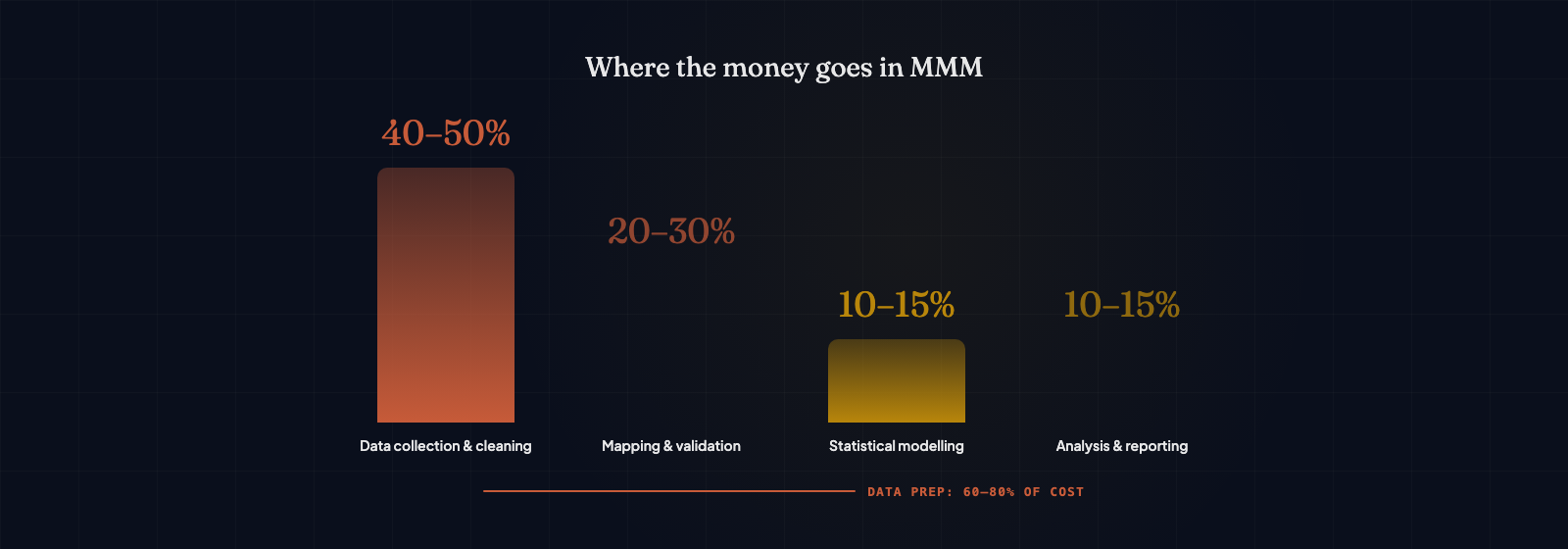
| Data collection & cleaning | 40-50% | Chasing data from agencies, platforms, internal teams. Reformatting, aligning granularity, filling gaps. |
| Data mapping & validation | 20-30% | Structuring cleaned data into model-ready format. Taxonomy alignment, variable creation, QA. |
| Modelling | 10-15% | Running the model, calibrating, testing scenarios. |
| Analysis & reporting | 10-15% | Interpreting results, building recommendations, presenting to stakeholders. |
| Total | 100% |
60-80% of the total cost is data preparation. This isn't controversial. Steve Lohr wrote about this in the New York Times back in 2014, and it hasn't materially changed. The industry just got better at hiding it inside project fees.
The implication: If you can automate data preparation, you don't just save time. You fundamentally change the economics of MMM.
Comparison of traditional vs AI-assisted MMM cost, timeline, and delivery value
Cost allocation in traditional MMM: majority spent on data preparation
How long does it take?
Traditional MMM timelines are painful. A typical engagement runs 3-6 months from kickoff to results, with the majority of that time spent in the data preparation phase. Some enterprise programmes take 12 months or longer when dealing with multiple brands and markets.
The problem isn't just cost—it's relevance. By the time results arrive, the planning cycle they were supposed to inform has already passed. This is why many marketing teams run MMM once and never refresh it.
The AI pricing shift
This is where the market is moving. AI—specifically pattern recognition and automated data mapping—can handle the bulk of that 60-80% data prep work. Not perfectly, and not without human oversight, but enough to dramatically change the time and cost equation.
Traditional MMM
- £80k-£150k per brand/market
- 3-6 month timeline
- Manual data prep
- Results arrive late
- Expensive to refresh
AI-Assisted MMM
- £15k-£30k per brand/market
- 3-6 week timeline
- Automated data prep
- Results while they matter
- Affordable to refresh quarterly
The modelling and analysis quality doesn't change. You're using the same class of models, the same statistical rigour, the same human interpretation at the end. What changes is that the slow, expensive manual work in the middle gets compressed.
Can small businesses use MMM?
Historically, no. At £100k+ per model, MMM was exclusively an enterprise tool. But the cost reduction from AI-assisted approaches is starting to open MMM to mid-market brands and even ambitious smaller companies. If you have 12+ months of marketing spend data across a few channels, an MMM is technically viable.
The question becomes: is the investment decision you'll make with the results worth the cost of the model? For a brand spending £500k+ per year on marketing, the answer is almost always yes.
Agency vs in-house vs hybrid
You have three routes, each with trade-offs. Large analytics agencies (Ekimetrics, Analytic Partners, Nielsen) offer deep expertise but at premium prices with long timelines. Building in-house capability gives you control but requires hiring scarce data science talent. The emerging hybrid model—using AI-powered tools with specialist oversight—offers the speed and cost benefits of automation with the quality assurance of experienced practitioners.
The right choice depends on your scale, frequency of modelling, and internal capability. But the trend is clearly toward the hybrid approach.