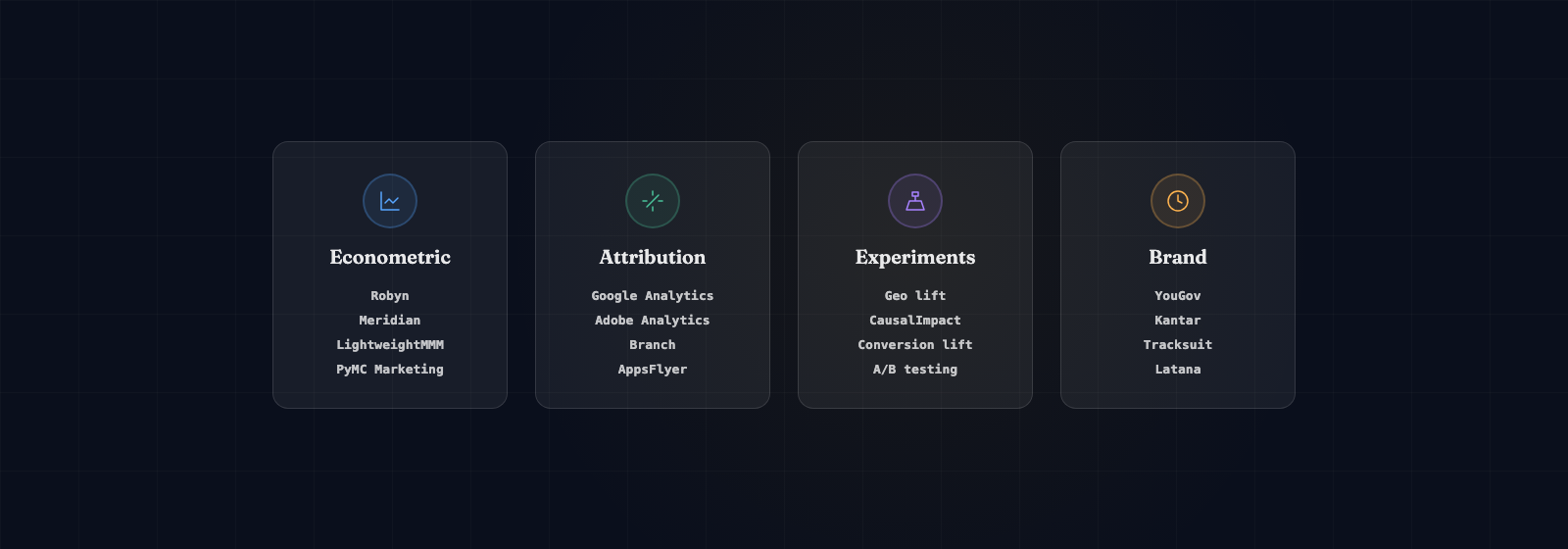
The measurement stack: what you need
Most teams buying marketing tools make the same mistake. They treat "measurement" as one thing when it's four completely separate layers. Buy the wrong layer for your problem and you'll waste time and money.
Think of your measurement stack like a building. You need the right foundation, but the foundation alone tells you nothing about how the building performs.
Layer 1: Web analytics. Your foundation. You need to see what's happening on your site. Events, sessions, behaviour. This is where most teams start and where many stop.
Layer 2: Attribution. This layer connects behaviour to sources. Where did that user come from? Which touchpoint gets credit? This is where opinions diverge and complexity increases.
Layer 3: Dashboarding and BI. This layer visualises your data and makes it accessible. A good dashboard saves people from living in spreadsheets. But a dashboard is not measurement. It's just the view.
Layer 4: Marketing mix modelling (MMM). This is where you answer the real question: how much did my marketing activity move the business? MMM sits at the top because it needs good data from the layers below.
Most platforms focus on one or two layers. Some try to do all four and do all of them poorly. Know which layer you're buying for.
Web analytics: GA4, Adobe, Matomo
Google Analytics 4 is the default choice and for most teams that's fine. It's free, it's integrated with Google's ecosystem, and setup is straightforward. The event model is flexible. The UI is clunky, but you get used to it.
The main weakness is data quality. GA4 has sampling issues at higher volumes. It struggles with offline data. Server-side tracking helps but adds work. If you're a mid-market B2B company with complex customer journeys, GA4 often falls short without significant engineering.
Adobe Analytics costs serious money and requires implementation expertise. If you have both, you get a platform that handles complexity well. Multi-touch attribution is built in. Custom segments are powerful. But implementation is weeks, not days, and you'll need ongoing support. Only worth it if you're measuring enough volume and complexity to justify the cost.
Matomo gives you on-premise control and a cleaner UI than GA4. Some teams like it for privacy reasons because you can self-host. The downside is that you're managing the infrastructure. You're also building your own integrations and custom analysis. Choose this if you have technical resources and privacy is a genuine blocker.
For most teams: GA4 is the answer. For enterprise with specific requirements: Adobe. For teams who want control and have engineering resources: Matomo.
Attribution platforms: understanding the limits
AppsFlyer, Branch, Adjust, and Ruler Analytics all solve the same problem: attributing conversions to sources. The implementation is straightforward. The philosophy is different.
AppsFlyer and Branch dominate mobile. They track installs and in-app events by integrating SDKs into your app. They're good at what they do. The limitation is that they only see mobile traffic. If you're running a mobile-first business they're essential. If mobile is one channel among many, you're getting a partial picture.
Adjust is similar to AppsFlyer but often feels like the second choice. If AppsFlyer isn't available in your region or doesn't support your use case, Adjust works. Don't force yourself into it if AppsFlyer fits.
Ruler Analytics is designed for B2B and works across web and phone calls. If your conversion path involves a phone call to a sales team, Ruler can track it. The implementation requires more setup than mobile SDKs but works well for companies with sales teams. The cost scales with call volume.
The honest truth about all attribution platforms: they show you where users come from and what they do. They don't tell you if that's good. They don't handle offline influence. They assume first-click or last-click or weighted attribution. None of these are "right".
Use attribution platforms to understand your funnel, not to make big optimisation decisions. That's what MMM is for.
Dashboarding and BI: making data accessible
Looker Studio (formerly Data Studio) is free and integrates with Google's tools. That's why most teams use it. You can build dashboards quickly. The performance is reasonable. The limitation is that Looker Studio is not a data warehouse. You can't do complex transforms. You can't run proper statistical analysis.
Use Looker Studio for KPI tracking and basic reporting. Don't use it as your source of truth for measurement decisions.
Tableau is the professional choice if you have budget. It's powerful. It handles complex datasets. It's easy to use once you learn it. Implementation is weeks, not hours. Cost scales with users. Worth it if you have 10+ people regularly using dashboards and complex analysis requirements.
Power BI is the Microsoft alternative. If you're already in the Azure ecosystem or using Office 365 heavily, Power BI makes sense. Otherwise, Tableau has better tooling. Most analytics teams would rather use Tableau.
The key point: your BI tool is valuable, but it's not doing measurement. It's doing reporting. Measurement means deciding what to measure, collecting the data correctly, and analysing it. A dashboard shows you the results but doesn't answer why.
Marketing mix modelling platforms: the serious measurement tool
This is where you measure marketing effectiveness. MMM uses statistical methods to isolate how much your marketing activity moved your business metrics, accounting for seasonality, trends, and external factors.
Meta Robyn is open source and free. It's a framework for building MMM models, not a platform. You need data science resources and Python knowledge to use it. If you have those resources it's powerful. If you don't, you're hiring someone to run it or moving to a platform.
Google Meridian is Google's newer MMM tool built from their internal systems. It's cloud-native and scales well. The pricing is opaque. You need to be on Google Cloud and likely have minimum spend requirements. Good choice if you're already Google-native and want integrated measurement.
Analytic Partners (now owned by Nielsen) is the enterprise choice. They've been doing MMM for decades. They have experienced analysts. The implementation is months and the cost is significant. You get what you pay for; the models are thorough and you get strategic guidance. Only consider this if marketing measurement is a strategic priority with budget to match.
Nielsen offers MMM services alongside their broader measurement offerings. Similar to Analytic Partners in scope and cost. They're deeply established with legacy relationships. If you're already with Nielsen for other measurement, adding MMM is straightforward.
Rix Digital is designed for the mid-market gap. Traditional MMM needs 2-3 years of clean data and weeks of analyst time to build models. Most teams don't have that. Our automated pipeline handles data preparation and works with open-source modelling tools so you can get results in weeks, not months. It's designed for teams that want MMM discipline without the enterprise consulting price tag.
The reality is that most teams skip MMM entirely. They can't justify the cost or complexity. That's a real limitation because MMM answers questions that attribution can't. But it requires data quality and time investment that many teams aren't ready for.
Tools versus methodology: the harder problem
Every marketer wants to buy their way to better measurement. Find the right platform and the problem is solved. It's rarely true.
You can have the best tools in the world and still not know if your marketing is working. The real work is deciding what to measure, setting up the data correctly, and then interpreting the results honestly.
A team with GA4 and a spreadsheet that thinks hard about causation will know more about their marketing than a team with expensive tools and no measurement discipline.
Before you buy another tool, answer these questions. If you can't answer them, the tool won't help:
- What's your actual business goal? Revenue, profit margin, market share? Not "awareness", not "engagement".
- How much time lag is there between marketing activity and the result you care about?
- What external factors move your business metric? Seasonality, competitive activity, price changes?
- How clean is your data? Can you trust your revenue numbers, your customer cost data, your media spend data?
- Who's going to use the results? If it's just the marketing director, tools are less important. If it's the whole leadership team, investment in dashboarding and communication matters.
Answer those questions first. Then buy tools that fit the answers.
What to buy first: a practical sequence
Stage 1: Foundation. Get GA4 set up properly. Event tracking, user identification, offline data if you have it. Spend a month on implementation, not a week. Most GA4 implementations are rushed and fail as a result.
Stage 2: Attribution clarity. If you're multi-channel, decide on an attribution model. Last-click, first-click, or weighted. Don't overthink this. Make a decision and move forward. Ruler Analytics for B2B with phone calls, AppsFlyer for mobile, nothing extra for pure digital web.
Stage 3: Accessibility. Build a Looker Studio dashboard showing your key metrics. Update it weekly. Get people used to looking at data regularly. This sounds simple but it's often the bottleneck.
Stage 4: Depth. If you're spending significant money on marketing and GA4 isn't telling you what's working, consider MMM. Start with Meta Robyn or Google Meridian if you have data science resources, or talk to a specialist like us. Move to a consulting firm only if you're at enterprise scale and have budget.
Don't jump to Stage 4 without nailing Stages 1 to 3. You'll waste money.
The common mistake: Teams buy expensive platforms before fixing their data foundations. You can have the world's best MMM platform, but if your GA4 tracking is broken or your revenue data is dirty, the results are worthless. Start with discipline, add tools after.
Making the decision
The right measurement tool depends on three factors. Your budget, your technical resources, and the complexity of what you're trying to measure.
A £2m marketing budget at a B2B SaaS company needs different tools than a £2m budget at an ecommerce business. Different channels, different conversion paths, different data maturity.
Get clear on your measurement goal first. Then pick tools that fit. Not the other way around.
The tools are the easy part. The hard part is deciding what to measure and committing to doing it right.