The trust gap
McKinsey research shows that 45% of CFOs have declined marketing budget proposals due to lack of evidence. Meanwhile, CMO Survey data reveals that 64% of CMOs can't prove marketing's impact quantitatively.
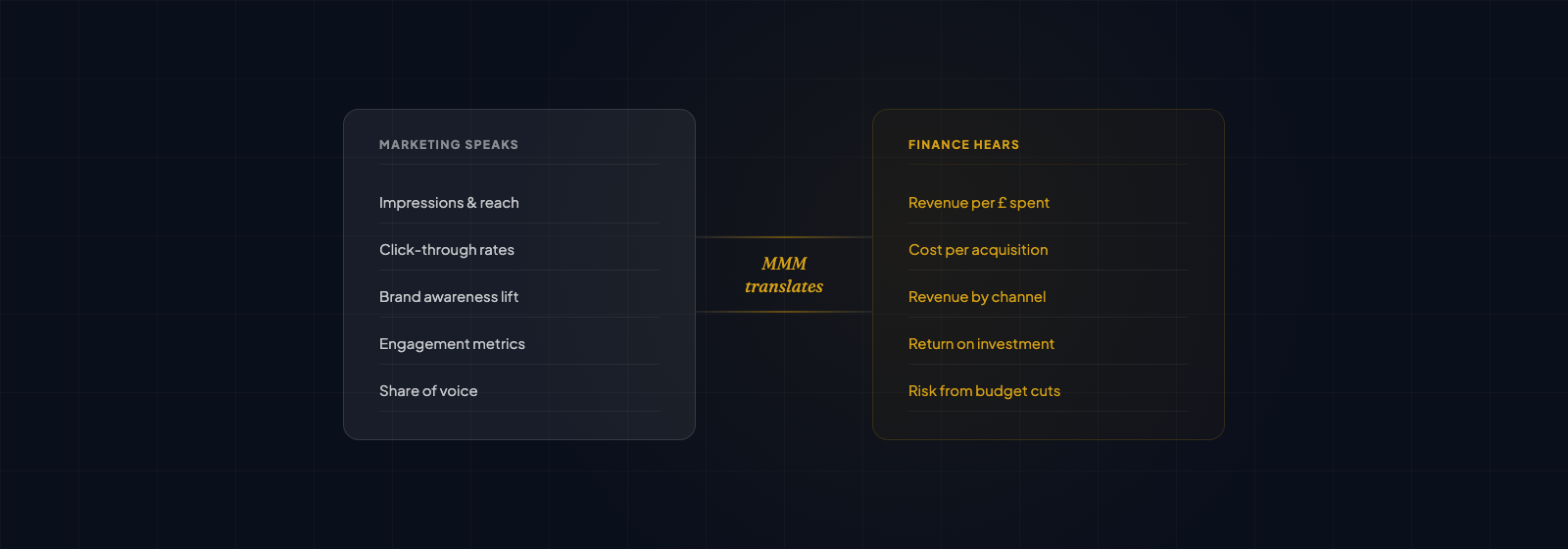
This isn't because marketing doesn't work. It's because marketers speak a different language to finance.
A marketer says: "We reached 10 million people. Our engagement rate improved to 3.2%. Cost per acquisition is down 18%."
A CFO hears: "Interesting. But what's the incremental revenue? What's my return? How do I know this investment is better than deploying the money elsewhere?"
These are fundamentally different questions. One is about activity. The other is about economics. Until you answer the CFO's question in their language, the trust gap stays open.
Why dashboards don't convince finance teams
You've probably built one: a beautiful dashboard showing impressions, reach, click-through rates, engagement rates, conversions. It tells a clear story about what marketing is doing.
A CFO doesn't care about any of it.
Not because they're dismissive. But because none of these metrics are financial metrics. A CFO thinks in terms of three things: incremental revenue, margin contribution, and return on invested capital. The conversion from marketing metrics to financial metrics is missing.
Your CPM (cost per thousand impressions) tells the CFO nothing about whether that spend generated revenue. Your CTR (click-through rate) doesn't translate to profit. Your engagement metric doesn't show up in the P&L.
The translation layer is broken. That's the real problem.
What finance wants to see
Stop trying to convince CFOs that marketing works in general. Instead, answer three specific economic questions:
- What would revenue look like without marketing? This is the baseline. The counterfactual. The thing marketing prevents from happening.
- What's the incremental return on each marketing pound? For every additional pound we spend on paid search, email, or TV, how much incremental revenue do we get? And is it above our cost of capital?
- What's the optimal level of marketing investment? Where does ROI start to decline? What's the sweet spot before diminishing returns kick in?
These are fundamentally economic questions. And they require econometric answers.
How marketing mix modelling speaks the CFO's language
Marketing mix modelling (MMM) is a statistical method that measures how different marketing activities drive sales. More importantly, it produces outputs that finance understands:
- Incremental revenue by channel. "Paid search generated £2.3 million in incremental revenue last year. Email generated £1.1 million." These are financial numbers, not activity metrics.
- ROI expressed as a multiple. "For every pound spent on TV, we generated £4.20 in incremental revenue." That's a 4.2x return. CFOs understand multiples immediately.
- A clear decomposition of what drives sales. Revenue isn't just marketing. It's also base demand (what you'd sell with zero marketing), pricing changes, promotions, seasonality, and external factors. MMM separates all of these. The CFO sees exactly what marketing is adding.
This is the same language used to justify every other investment in the business. When you propose a new factory, you show incremental revenue, ROI, and payback period. Marketing should be no different.
MMM creates a clear path from investment to financial evidence to decision
The decomposition chart: your most powerful weapon
There is a single visualization that has more credibility with CFOs than anything else: the decomposition chart.
It takes total sales and breaks it down into components:
- Base demand (what would happen with zero marketing)
- Paid search contribution
- Paid social contribution
- TV contribution
- Email contribution
- Other factors (seasonality, pricing, competitor activity)
The CFO can see exactly what marketing is adding. It's not a claim. It's not a correlation. It's a statistical decomposition with confidence intervals. The model shows uncertainty ranges. The numbers are defensible.
This chart is powerful because it's transparent. A CFO doesn't have to trust you. They can see the math. They can see the assumptions. They can argue about the model. But they can't dismiss the fundamental insight: marketing is contributing X incremental revenue.
Example CFO-ready metrics dashboard with financial language and ROI multiples
The most effective marketing teams we work with don't use MMM to ask for more budget. They use it to show how the current budget could work 15-20% harder. That's a conversation every CFO wants to have.
Building ongoing credibility, not one-off proof
A single MMM study impresses a CFO once. But one-off proof doesn't build lasting trust.
The brands that maintain marketing budgets through downturns are the ones that can show, quarter after quarter, what marketing is delivering. They refresh the model regularly. They track actual incremental revenue against forecast. They update the decomposition as new data comes in.
This transforms the conversation. Instead of: "We need more budget for growth," it becomes: "We've delivered 12% incremental revenue this quarter. Our model forecast 10%. Here's what we can achieve next quarter if we reallocate budget to paid search."
That's a conversation the CFO wants to have. Because it's based on evidence, not intuition.
The practical first step
You don't need a six-month project to prove this works for your business.
Start small. Pick one brand or one market. Gather two years of historical data: your marketing spend by channel, and your sales data at weekly or monthly level. Bring in any external factors that matter (seasonality, competitor activity, major promotional calendars).
Build a simple MMM model. Generate the decomposition chart. Show the CFO: "Here's what marketing contributed. Here's the ROI. Here's what we'd recommend to optimize this." Let the results make the case for expanding the programme across other brands or markets.
The data will speak louder than any presentation. And once the CFO sees the numbers, the conversation shifts from "prove marketing works" to "where should we invest to maximize returns."
Moving forward
The fundamental truth: CFOs don't doubt that marketing works. They doubt that marketers can quantify it. That's the real gap.
Close it by speaking their language. Show incremental revenue, not impressions. Show ROI, not engagement. Show decomposition, not correlation. And most importantly, do it with evidence. With numbers. With a model that can be challenged, defended, and improved.
That's how you keep marketing budgets through downturns. And that's how you earn the CFO's trust.