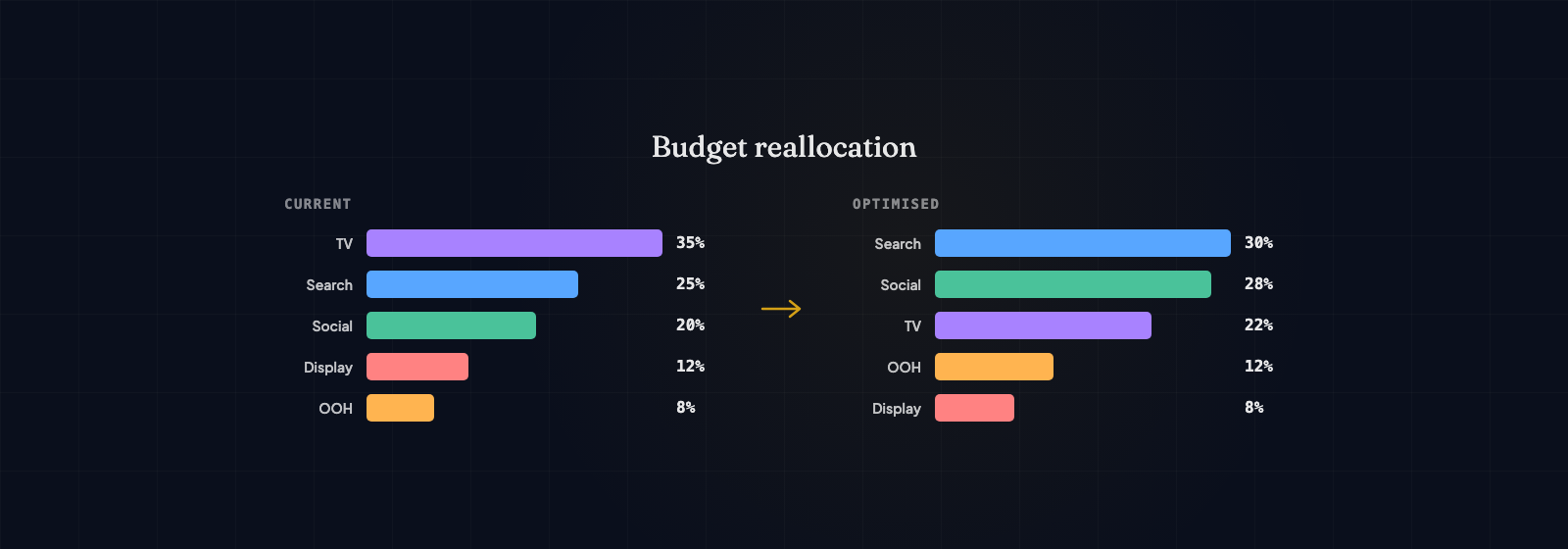
Budget reallocation is where MMM earns its money
Knowing which channels deliver ROI is interesting. Understanding your full marketing mix is valuable. But the real business impact sits somewhere else: moving budget based on what the data shows.
Most brands run marketing mix models, look at the results, nod thoughtfully, and then do nothing. The allocation stays the same. The budget still flows to the same channels in the same proportions. Next year, they do it again.
This is where most MMM projects fail to deliver value. The analysis is sound. The recommendations are solid. But the organization doesn't act on them. Reallocation requires more than good data. It requires business judgment, organizational will, and understanding of the constraints that make certain moves impossible.
A good analyst knows the ROI curves. A good strategist knows when to move budget and when to hold. The best reallocation exercises combine both.
Why most reallocation exercises fail
Three patterns emerge when reallocation attempts don't stick:
Problem 1: The data is stale
Your MMM was built on data from 18 months ago. The market has moved. Competitive dynamics have shifted. Channel costs have changed. A 2024 model recommending digital increases based on 2024 ROI might miss that digital costs have doubled and saturation has set in.
This is why static reallocation plans age badly. The data degrades. The recommendations become less relevant. By the time budget shifts, the window for capturing those gains has closed.
Problem 2: The recommendations are too radical
The model says cut TV by 50% and shift to social. Technically, that might be optimal. Realistically, nobody's doing it. Your TV agency has contracts. Your brand relationships in retail depend partly on TV presence. Your CFO isn't comfortable with that kind of volatility. Internal politics aren't going to allow it.
The best reallocation plan is one the business will execute. A 15% shift the company commits to is better than a 50% shift that never happens.
Problem 3: The analyst doesn't understand business context
Pure MMM optimization is mathematical. Shift from low-ROI to high-ROI channels, maximize sales, done. But marketing doesn't work in a vacuum. You have brand health considerations. Audience reach requirements. Competitive positioning. Retail relationships. Customer acquisition mix. Retention strategies.
A recommendation to cut brand-building spend (TV, OOH) by 30% might maximize short-term sales but damage long-term brand value. The person making the reallocation decision needs to see this. A good analyst explains not just the ROI numbers but the trade-offs.
You don't need to change everything at once. A 10-15% reallocation based on data typically delivers more impact than a 30% budget increase spent in the same proportions.
The reallocation process
Here's the framework that works:
Step 1: Understand current ROI by channel
Run your MMM. Get the ROI curves for each channel. Understand not just the headline ROI (revenue per pound spent) but the shape of the curve. Where are you on the elasticity curve for each channel? Are you in a zone of strong returns, declining returns, or severe saturation?
Digital channels typically show stronger ROI early but steeper decline as you scale. TV and OOH show different patterns: slower initial returns but more stability at higher spend levels. Brand-building channels work differently from direct response channels.
Step 2: Identify the biggest gaps
Compare current allocation to optimal allocation. Where is the biggest mismatch between what you're spending and what the ROI curves suggest you should spend?
Look for two patterns specifically:
- Overspend relative to returns: High spend, declining ROI. You're in the saturation zone. Further spend generates minimal additional sales.
- Underspend relative to opportunity: Moderate spend, strong ROI. The curve is still steep. Incremental spend would generate good returns.
The biggest reallocation opportunity sits in the gap between these two. Move from the first to the second.
Step 3: Start with easy wins
Don't start with the channel that's politically difficult to touch. Start with obvious inefficiencies that everyone will acknowledge.
Channel A: £5M spend, £2.50 ROI, flat curve (saturation). Channel B: £2M spend, £6.00 ROI, steep curve (opportunity). This is an easy win. Reallocate £500k from A to B. Both sides can see the logic. It's not criticism, it's optimization.
Once you've moved that money and the results confirm the model's predictions, you have proof. That proof makes the next reallocation conversation easier.
Step 4: Propose incremental shifts
Rather than "cut Display by 40%", say "shift 12% of Display to Social." The former sounds like elimination. The latter sounds like optimization. Both might be mathematically identical, but the framing matters for execution.
Incremental shifts of 5-15% are easier to defend, easier to implement, and easier to reverse if results don't match predictions. They feel like tests rather than permanent decisions.
Step 5: Test and re-measure
After reallocation, measure results against the model's predictions. Did the expected uplift materialize? Did other channels behave as the model suggested?
This serves two purposes. First, it validates or improves your model for future decisions. Second, it builds confidence in the process. When the model predicts a shift will generate an extra £400k in sales and it does, the next reallocation proposal faces less skepticism.
What realistic reallocation looks like
Here's a concrete example (anonymized brand, real situation):
A FMCG brand spent across six channels: TV (£8M), Digital Display (£4M), Paid Search (£3M), Social Media (£2.5M), Out-of-Home (£2M), Direct Mail (£500k).
The MMM analysis showed:
- TV: £8M spend, £3.20 ROI, declining curve. Strong brand-building effect but reaching saturation. Every additional pound generates less incremental sales.
- Digital Display: £4M spend, £2.80 ROI, flat curve. Over-indexed on cost. Digital costs have inflated. The channel is underperforming relative to spend.
- Paid Search: £3M spend, £4.10 ROI. Stable. Direct response generating predictable returns. Mature channel.
- Social Media: £2.5M spend, £5.40 ROI, steep curve. Under-indexed. The channel has capacity. ROI is strong. Spend could increase without hitting saturation.
- Out-of-Home: £2M spend, £3.50 ROI. Supporting TV effectively. Halo effects substantial.
- Direct Mail: £500k spend, £2.10 ROI. Declining effectiveness. Aging audience. Low priority.
The recommendation: Shift 12% of Display budget (£480k) to Social. Expected outcome: £240k incremental annual revenue with zero increase to total marketing spend.
Why this specific reallocation?
Display is the easiest to defend moving because the data shows clear underperformance. Social is the highest-opportunity channel with capacity for more spend. The shift is incremental (not radical). And the numbers are conservative — the model showed Social could absorb £1M+ before hitting saturation, so reallocating £480k is a test, not a commitment.
Results after six months: Social ROI increased slightly (more spend, slightly declining curve) to £5.15. Display ROI improved (lower spend, operational efficiencies) to £3.20. Overall uplift: £220k against the £240k prediction. Close enough. The model proved sound.
Next reallocation: Knowing the model works, the team feels confident moving another £300k from Display to Social the following year.
The political reality
Here's what happens in the room when you propose reallocation:
The TV buyer: "We can't cut TV. Brand awareness research shows TV is critical to our positioning. And we have an upfront commitment through 2027." Translation: Yes, the numbers show weakness, but I have political cover and multi-year deals that make this change impossible.
The digital agency: "Display is more sophisticated now. The data is old. We've optimized targeting since the model was built. ROI has probably improved." Translation: Don't cut my biggest revenue line.
The CFO: "A 12% shift sounds fine but let's be conservative. How about 5%?" Translation: The data makes sense but I'm uncomfortable with volatility.
None of this is irrational. It's normal. Reallocation is genuinely difficult because marketing isn't just about ROI anymore — it's about brand positioning, customer reach, competitive dynamics, and organizational politics.
The best approach: Frame reallocation as optimization of the whole, not criticism of parts. You're not saying "Digital Display is bad." You're saying "We want to make the total marketing mix work harder. Here's where we can do that without upsetting other priorities."
Use data to build consensus, not to win arguments. Show the opportunity. Explain the trade-offs. Propose a test rather than permanent change. And expect — and plan for — the political friction.
How often should you reallocate?
Minimum: annually. Ideally: quarterly.
Here's why quarterly makes more sense than most people think:
- Markets change: Channel effectiveness fluctuates. Digital costs vary seasonally. Competitive intensity shifts. A model from Q3 is partially out of date by Q4.
- Your data improves: Every quarter gives you more historical data. Your model gets more accurate. Older quarterly checks build confidence in the system.
- Small changes compound: Four 5% reallocations beat one 20% reallocation. They're easier to execute, less politically fraught, and easier to reverse if needed.
- Competitive dynamics: Competitors reallocate. Channel costs shift. Your audience behavior changes. Staying static while the market moves is a choice — usually a bad one.
That said, quarterly reallocation requires a lean process. You're not rebuilding the full model each quarter. You're running quarterly health checks: Have the ROI curves shifted materially? Are there new opportunities? Are previous recommendations still valid?
Full MMM rebuilds can stay annual or bi-annual. Quarterly reviews can be lighter-weight analysis checking if the big picture has changed.